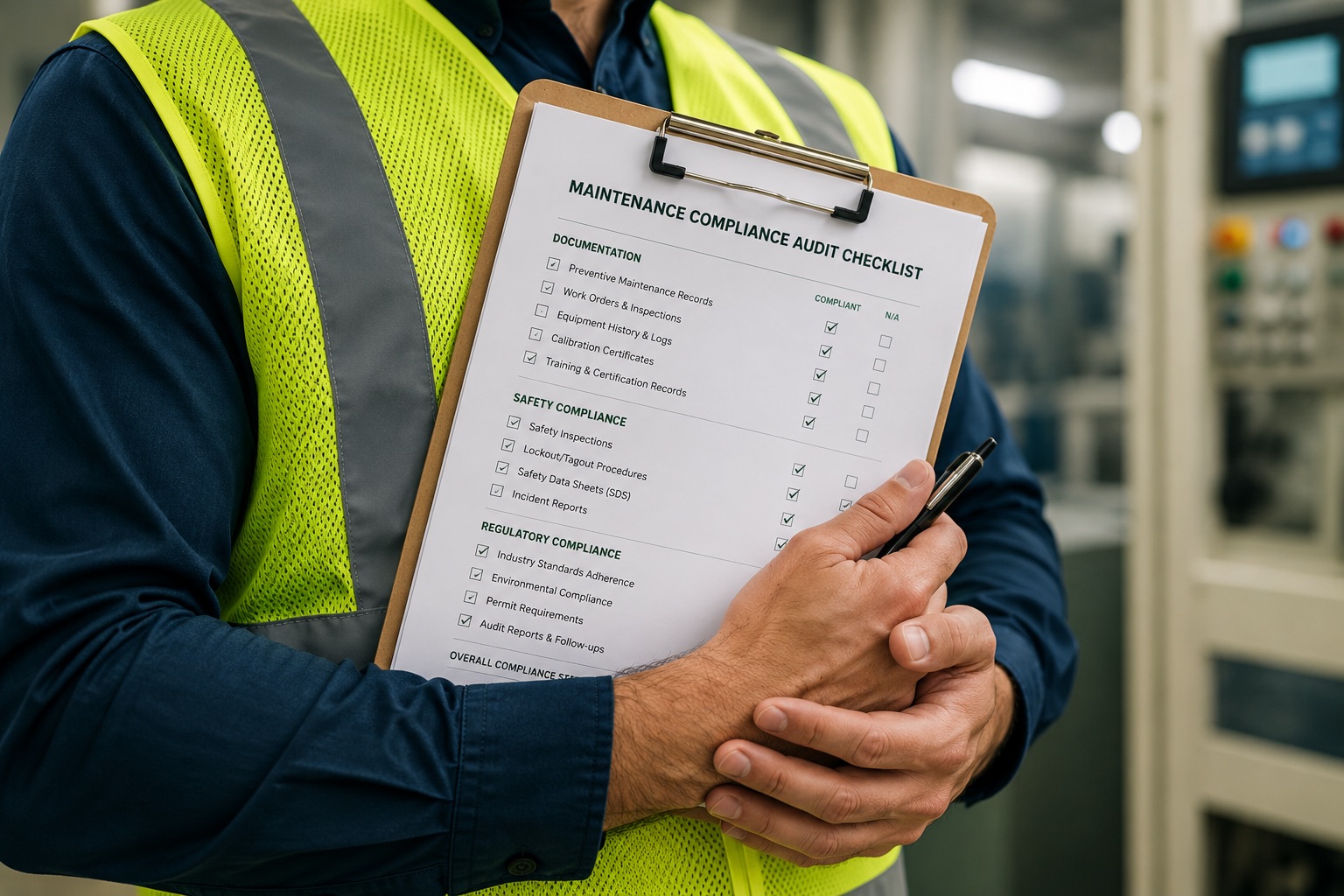
Introduction
A compliance audit is not the time to discover that your maintenance records have gaps, that PM completions were logged weeks after the fact, or that no one can produce a calibration certificate for a critical piece of equipment. Yet this is exactly the situation many facilities managers face when an OSHA inspector arrives or a Joint Commission survey team walks through the door.
Maintenance compliance is ultimately a documentation problem. The work may have been done correctly — but without a reliable, timestamped, auditable record, you cannot prove it. This guide covers the compliance frameworks that most directly affect maintenance operations, what documentation auditors actually look for, and how a modern CMMS makes audit readiness a byproduct of daily operations rather than a quarterly scramble.
Compliance Frameworks That Affect Maintenance Operations
OSHA (Occupational Safety and Health Administration)
OSHA regulations touch nearly every aspect of industrial and facility maintenance in the United States. The most consequential standards for maintenance teams include:
- NFPA 70E / OSHA 1910.331-335: Electrical safety, lockout/tagout procedures, and qualified worker documentation
- 29 CFR 1910.147: Control of hazardous energy — requires documented LOTO procedures for each piece of equipment
- 29 CFR 1910.119: Process Safety Management — requires documented inspection and maintenance records for process equipment
- 29 CFR 1926 (Construction): Applies to maintenance activities classified as construction work
OSHA inspectors specifically look for written procedures, training records, equipment inspection logs, and evidence that corrective actions were completed and documented.
EPA Regulations
Facilities that handle refrigerants, hazardous chemicals, or fuel storage systems face EPA compliance requirements with significant maintenance documentation components:
- Section 608 (Refrigerant Management): Records of refrigerant purchases, recovery, and leak repairs must be retained for three years
- 40 CFR Part 112 (SPCC): Spill Prevention, Control, and Countermeasure plans require documented inspections of fuel storage and transfer equipment
- Clean Air Act Title V: Requires maintenance records for pollution control equipment
The Joint Commission (JCAHO)
Healthcare facilities seeking or maintaining Joint Commission accreditation face some of the most rigorous maintenance documentation requirements in any industry. The Environment of Care (EC) standards require:
- Documented preventive maintenance on all life-safety and medical equipment
- Evidence that equipment is maintained on schedule or that deferred maintenance is risk-assessed and documented
- Inspection records for fire protection systems, medical gas systems, and emergency power
- Complete equipment inventories with maintenance history
Joint Commission surveyors frequently request maintenance records going back 12-24 months. Organizations that rely on paper or spreadsheet-based records often cannot produce these quickly enough.
ISO 55000 (Asset Management)
ISO 55000 is not a regulatory requirement in most jurisdictions but is increasingly required by enterprise customers and parent organizations. It provides a framework for managing physical assets throughout their lifecycle and requires:
- Documented asset management plans
- Maintenance strategies based on risk and criticality
- Evidence of maintenance execution against those plans
- Continual improvement processes driven by performance data
Additional Frameworks by Industry
- FDA 21 CFR Part 820 / EU MDR: Medical device manufacturers must maintain equipment calibration and maintenance records
- SQF / FSMA: Food safety frameworks require documented sanitation and equipment maintenance programs
- NERC CIP: Electric utility maintenance of critical cyber-physical assets
- ISO 9001: Quality management systems require controlled maintenance procedures and records
What Auditors Actually Look For
Understanding the mindset of a compliance auditor helps maintenance teams focus documentation effort where it matters most.
Completeness
Auditors want to see that every required inspection or maintenance task has a record. A gap in the PM schedule — even one missed task — raises questions about what else may have been skipped. Complete records demonstrate a functioning maintenance program, not just selective documentation.
Timeliness
Records that show maintenance tasks completed within the required interval carry more weight than backdated entries or batch updates. Timestamped digital records are far more credible than paper logs completed at the end of a shift or week.
Attribution
Who performed the work? Was that person qualified to do it? Auditors look for technician identification, relevant certifications or training records, and — in some regulated industries — supervisor sign-offs on completed work.
Corrective Action Closure
Finding a deficiency is less problematic than failing to act on it. Auditors examine whether identified issues were escalated, assigned, and resolved within a reasonable timeframe. An open corrective action backlog with no follow-through is a significant finding in most frameworks.
Calibration and Testing Records
For life-safety systems and process-critical equipment, auditors want documentation that instruments and control systems were calibrated to specification and that testing was performed and passed — with the test results on record.
Building an Audit-Ready Documentation System
Define Documentation Standards Before the Audit
Establish clear standards for what constitutes a complete maintenance record in your organization:
- Required fields on every work order (technician, start time, completion time, parts used, findings)
- Mandatory photo capture for specific equipment types
- Signature requirements for life-safety and regulatory-critical tasks
- Retention periods by record type and regulatory requirement
Align PM Schedules With Regulatory Intervals
Map each regulatory requirement to a PM task in your CMMS. If OSHA requires annual LOTO procedure reviews, there should be an annual PM work order for that review. If EPA requires quarterly fuel tank inspections, that interval should be configured and enforced in the system. Do not rely on individual memory or informal reminders for compliance-driven maintenance.
Close the Loop on Deficiencies
Every finding from an inspection, whether internal or external, should generate a corrective action work order with an assigned owner, due date, and priority level. The CMMS becomes the system of record for both the finding and its resolution — which is exactly what auditors want to see.
Conduct Internal Audits on a Regular Cadence
Organizations that perform monthly or quarterly internal compliance reviews rarely struggle in external audits. Internal reviews surface documentation gaps, overdue PMs, and missing records while there is still time to address them.
A manufacturing client conducting monthly internal audits reduced their OSHA audit findings from eleven citations to zero over a two-year period.
How a CMMS Automates Compliance Readiness
Automatic Audit Trail Creation
Every action in a CMMS generates a timestamped log entry: who created a work order, who was assigned, when work started, when it was completed, what was recorded. This audit trail is created automatically as a byproduct of normal operations — no additional documentation effort required.
PM Compliance Dashboards
A maintenance manager should be able to see, at any time, what percentage of scheduled PMs have been completed on time this month, this quarter, and this year — and which specific tasks are overdue. Compliance dashboards make this information available without manual report generation.
Overdue Task Escalation
When a compliance-critical PM falls overdue, the CMMS should automatically escalate via notification to the responsible supervisor or manager. Automated escalation ensures that regulatory deadlines do not slip through the cracks during busy periods.
Document and Certificate Management
Attach calibration certificates, inspection reports, manufacturer service records, and training certificates directly to asset records in the CMMS. When an auditor asks for the last calibration certificate for a specific instrument, it should be retrievable in under a minute.
Instant Report Generation
Auditors frequently request summaries: all PMs completed in the last 12 months for a specific asset class, all corrective actions opened and closed in a given period, all instances where a task was completed outside the required interval. A CMMS with strong reporting capability produces these reports on demand rather than requiring hours of manual data compilation.
Preparing for an Audit: A Practical Checklist
When an audit is scheduled — or when one arrives unannounced — the following steps give your organization the best chance of a clean result:
- Run a PM compliance report for the past 12 months and identify any gaps
- Verify that all overdue work orders have either been completed or have documented justification for deferral
- Confirm that calibration certificates and inspection records are attached to relevant asset records
- Review the corrective action backlog and escalate anything approaching a regulatory deadline
- Ensure technician training and certification records are current and linked to the individuals performing regulated work
- Pull a sample of recent work orders and verify they meet your documentation standards
Conclusion
Compliance audits are stressful when maintenance documentation is scattered across paper logs, spreadsheets, and individual memory. They are straightforward when every task, finding, and corrective action is captured in a single, searchable, timestamped system of record.
A CMMS does not just help you pass audits — it changes the nature of audit preparation from a crisis response to a routine check. FacilityLane is designed with compliance at its core, providing automatic audit trails, configurable PM schedules aligned to regulatory intervals, document management, escalation workflows, and on-demand compliance reporting.
If your current documentation approach has you holding your breath when an inspector walks through the door, it is time to build a better foundation. Request a demo to see how FacilityLane makes audit readiness a byproduct of doing the work.